Patronal Feast of the Parish
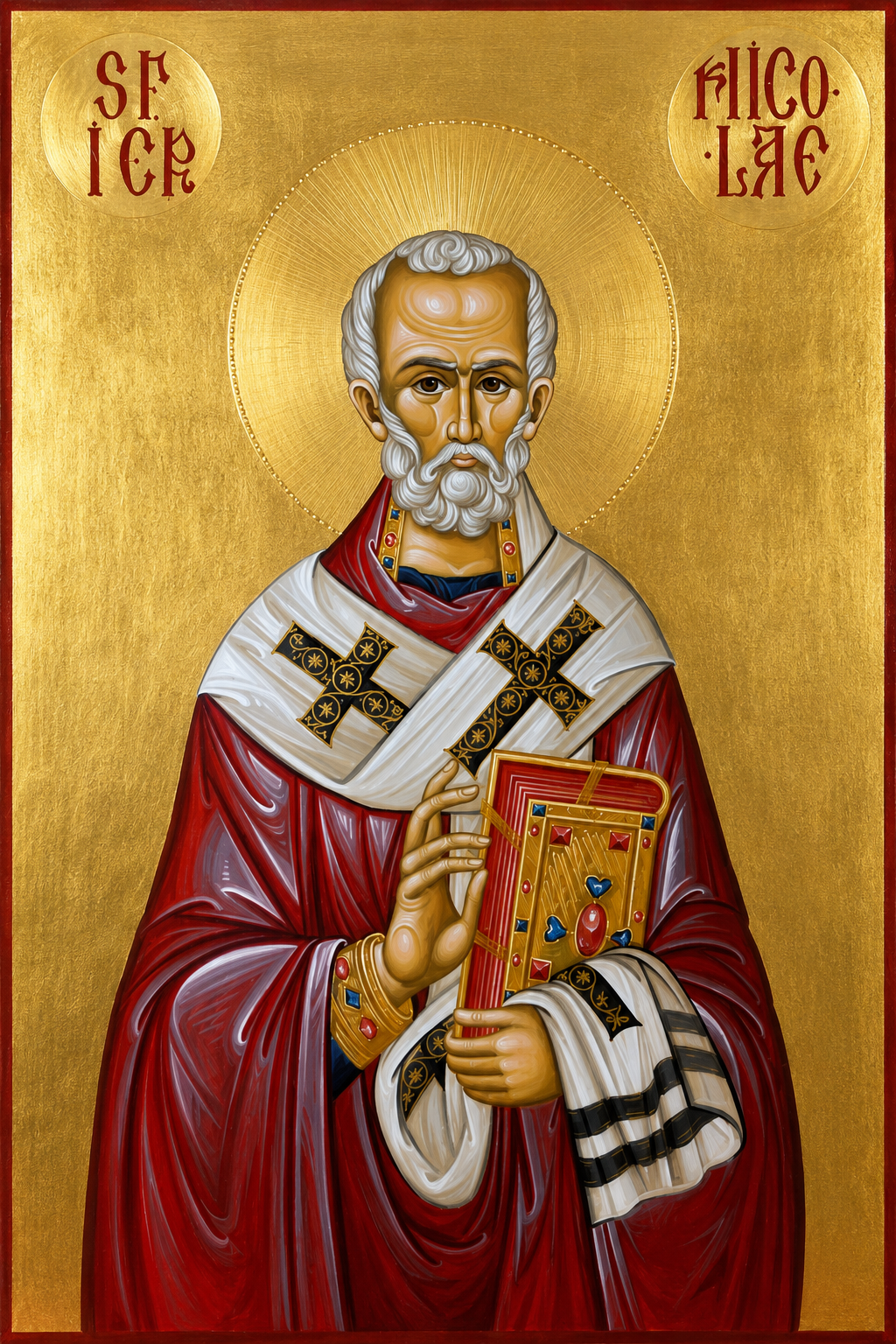
Saint Nicholas the Hierarch
Archbishop of Myra in Lycia, Wonderworker
Feast Days
19 December — The Dormition of Saint Nicholas
Main feast day. The saint passed away around the year 345 AD.
22 May — The Bringing of the Holy Relics to Bari
Commemoration of the transfer of the relics from Mireele in Lycia to Bari (Italy) in 1087.
The Life of Saint Nicholas the Hierarch
Saint Nicholas was gentle, free from malice and humble in spirit, shunning pride. He was a father to the needy; merciful to the poor; a comforter to those who wept, a helper to the afflicted, and a great benefactor to all.
This great wonder-worker, swift helper and most chosen intercessor before God, the bishop of Christ, Nicholas, was born in the region of Lycia, in the city known as Patara, to honourable parents of noble lineage, who were devout and wealthy. His father’s name was Theophanes, and his mother’s, Nona. This blessed couple, living faithfully in lawful matrimony and adorned with virtuous conduct, through their life pleasing to God and their many acts of charity and great good deeds,were deemed worthy to bring forth this holy offspring – they themselves being the holy root – and it came to pass as the psalmist says: ‘Like a tree planted by the streams of water, which yields its fruit in season.’ Thus, having given birth to this divine child, she named him Nicholas, which means ‘conqueror of the people’; and indeed he proved himself a conqueror of evil, as God willed for the common good of the world.
After that birth, his mother Nona remained barren until she was released from the bonds of this earthly life, bearing witness herself that it was not possible for another son like him to be born, for she was to have only this one, first and last, who was sanctified from his mother’s womb by the gift breathed into him by God. For he began his life only by honouring God with true piety; nor did he begin to suckle at the breast, performing miracles from infancy; nor did he first learn to eat, but to fast. For after his birth, whilst in the bath, he stood for three hours on his own two feet, unaided by anyone, thereby honouring the Holy Trinity, to Whom he was later to be a great servant and chief minister. When he drew near his mother’s breast, he was recognised as a miracle-worker, feeding not as other infants do – for he suckled milk only from the right breast – and was thus destined to attain the place on the right hand among the righteous.
Then he also began to be a chosen faster, for on Wednesdays and Fridays he would suckle from the breast only once, and that in the evening, after the customary Christian prayers had been said; at which his parents were greatly astonished and marvelled, and even then they foresaw what sort of faster Nicholas would become in later life. The Blessed One acquired this habit of fasting whilst still in his nappies and maintained it throughout his life, right up to his blessed passing, observing fasting on Wednesdays and Fridays. Thus, as the child grew in years, so too did his understanding and his good habits, which he learnt from his virtuous parents; for he was like a fertile field, which receives within itself the seed of sound teaching, which sprouts and bears fresh fruit of good deeds day by day.
When the time came for him to attend school, he was entrusted to the teaching of the Holy Scriptures, and with his natural quickness of mind and the guidance of the Holy Spirit, he attained great wisdom in a short space of time. He then progressed so far in his studies as was necessary for a good helmsman of the ship of Christ and a skilful shepherd of the speaking flock. Thus, having become consummate in the word of teaching, he proved himself consummate in the conduct of his life as well; he turned away entirely from frivolous friends and idle talk, and he took great care to avoid speaking to women or casting his eyes upon a woman’s face, for he would flee and keep his distance from the company of women.
Possessing true wisdom and a pure mind, he ever beheld God and always lingered in the holy churches, as the prophet says: ‘I have chosen to dwell in the house of my God’. Often, for a whole day and a whole night, spending his time in prayer focused on God and in the reading of the divine Scriptures, he acquired spiritual understanding and was enriched with the divine gifts of the Holy Spirit, with which he prepared himself to be a worthy dwelling place, as it is written: ‘You are the church of God, and the Spirit of God dwells within you.’
Thus, this refined and pure young man, having within him the Spirit of God, appeared entirely spiritual, burning with zeal and serving the Lord with reverence, so that no trace of youthful folly was seen in him, but only the habits of an elderly man, for which he was marvelled at and glorified by all. For just as an old man, if he behaves like a young man, is mocked by all, so too a young man, if he possesses the demeanour of an old man, is honoured by all with wonder; for the ways of youth are ill-suited to old age, but the ways of old age are honourable and beautiful in youth.
Blessed Nicholas had an uncle who was a bishop and bore the same name as himself. His uncle, seeing his nephew growing in virtue and turning his back entirely on the world, advised his parents to dedicate him to the service of God. And they did not refuse to give their son to the Lord, whom they had received as a gift from Him. For it is written in the ancient books of their people that, being childless and having despaired of ever having children, they asked God for this son with many prayers, tears and acts of charity; and they offered him as a gift to the One who had bestowed him upon them.
The bishop received the young man who was as wise as one of advanced years and whose life was most pure; he led him up the hallowed steps of the priesthood, and when he was ordained, the bishop turnedto the people in the church and, filled with the Holy Spirit, prophesied, saying: ‘Behold, brothers, I see a new sun rising at the ends of the earth, appearing to the afflicted as a merciful comfort. O! Blessed is the flock that shall be deemed worthy to have this shepherd! For he will tend the souls of the straying well and lead them to the pasture of the true faith; then he will also prove a fervent helper to those in need.” This prophecy was later fulfilled, as we shall show in the account we are about to give.
Thus, having been ordained a priest, Saint Nicholas added labour upon labour, spending his days in fasting and ceaseless prayer, whilst striving with his mortal body to follow those who are incorporeal. Thus, living just as the angels do, day by day he blossomed more and more with the adornment of his soul and proved himself worthy of the leadership of the Church.
At that time, his uncle, Bishop Nicholas, wishing to travel to Palestine to worship at the holy sites there, entrusted the entire governance of the Church to his nephew. Thus, taking his place, he took full charge of the administration of the churches, just as his uncle the bishop had done. At that time, the blessed man’s parents, having departed from this temporal life, passed into the eternal one, and Saint Nicholas, having inherited their estate, distributed it amongst the poor. For he did not set his heart on the wealth that flowed around him, nor did he concern himself with increasing it; but, having renounced all worldly desires, he strove with all his might to be united with God, to whom he said: ‘To You, O Lord, I have lifted up my soul; teach me to do Your will, for You are my God; to You I have been cast from my mother’s womb, You are my God’. Thus his hand was stretched out to the poor, like a river with abundant water flowing freely.
So that his many acts of charity might be more readily known, let us recount one in particular: There was a man in that city, one of the honoured and wealthy, who later became poor and obscure, for the life of this world is fickle. That man had three very beautiful daughters, and now, being deprived of all necessities, he had neither food nor clothing, and he considered giving his daughters into debauchery, and to turn his home into a den of iniquity, because of his great poverty, thinking that only in this way would he gain some benefit and secure clothing and food for himself and his daughters. Alas, to what ungodly thoughts does great poverty drive a man! So, that old man, being in such evil thoughts, and his wicked mind now seeking to carry them out with wickedness, God, Who does not wish to see human nature perish, but out of love for mankind bends down to our needs, placed kindness in the heart of His beloved, Saint Nicholas, andsent him to the aid of the man whose soul was about to perish, through a mysterious inspiration, comforting him in his poverty and saving him from the fall into sin.
Thus, when Saint Nicholas heard of that man’s great need and, through divine revelation, became aware of his evil thoughts, he felt great pity for him and resolved that, with his benevolent hand, he would rescue him and his daughters as from a fire, delivering them from poverty and sin. However, He did not wish to be in the presence of that man to tell him of His act of kindness, but, in secret, He resolved to bestow His mercy upon him with compassion. And she wished to do this for two reasons: firstly, to avoid human praise, for she bore in mind what the Gospel says: ‘Take heed that you do not practise your almsgiving before men’; and, secondly, so as not to put that man to shame—who had once been rich, but had now fallen into great poverty, so as not to put him to shame; for she knew that such things are hard for those who, having fallen from wealth and honour into poverty, are ashamed in their hearts, being reminded of the wealth they once possessed. For this reason, he resolved to act in accordance with Christ’s words: ‘Let not your left hand know what your right hand is doing’. For he shunned human glory so much that even from the very person to whom he was doing good, he took care to conceal himself.
So, taking a large bundle of gold coins, he went in the dead of night to that man’s house and, throwing it in through the window, quickly returned to his own home. In the morning, when the man awoke and found the bundle, he untied it and, upon seeing the gold coins, was terrified, for he thought it must be some sort of illusion, fearing that the gold he saw might be a trick, since he was expecting no kindness from anyone or anywhere. Therefore, turning the gold coins over with his fingertip, he looked at them intently; and realising that it was true, he rejoiced and marvelled, and in his joy, he wept hot tears; and, pondering long within himself as to who might have done him such a kindness, he could not fathom it. So, believing it to be God’s providence, he gave thanks to Him unceasingly, praising the Lord who cares for all. Then, straight away, he married off one of his daughters, the eldest, to a man, and gave her enough of the gold he had received to cover her dowry.
When the wonderful Nicholas learnt of this—that the man had acted in accordance with his will—he was pleased. And once again he showed himself ready to extend the same mercy to the old man’s second daughter, endeavouring to protect this maiden too through a lawful marriage from the sin of fornication. So he prepared another bundle of gold coins, just like the first, and, under cover of night, keeping his distance from everyone, he threw it through the same window into the old man’s house.
In the morning, when that poor man awoke, he found gold once more, just as he had the first time. Then he began to marvel at this too, and, falling face down on the ground, he gave thanks with hot tears, saying: ‘O God, the source of mercy and the architect of our salvation, who firstredeemed me with Your Blood, and now, by delivering my household and my daughters through gold from the snare of the evil one, show me Yourself the one who serves Your merciful will and Your love for mankind. Show me Your earthly angel, the one who guards us from the ruin of sin, so that I may know who is such a one, who lifts us out of the poverty that grieves us and who delivers us from evil thoughts; for behold, by Your mercy, O Lord, through Your secret compassion, by the hand of Your beloved, I shall also give my second daughter in lawful marriage to a husband, and thus I shall escape the snares of the devil, who seeks, through ill-gotten gain, to bring me great loss’.
Then that man, praying to the Lord and giving thanks for His goodness, arranged a wedding for his second daughter as well, placing his hope in God – for he had placed his unshakeable hope in Him – that He would also provide for his third daughter and grant her too a loving husband, according to the law, sending her once more ample gold, again through that benevolent hand. Therefore, he lay awake at night, keeping watch, so that he might sense the benefactor and be worthy to see from whence he brought that gold. And lo and behold, not long afterwards, the one he had been awaiting arrived. For the beloved of Christ, Nicholas, came for the third time, and, reaching his usual spot, he once again threw a bundle of gold coins through the same window and immediately returned to his home. The girls’ father, finding the gold thrown through the window, immediately ran as fast as he could after the man returning to his home; and when he caught up with him and recognised who he was – for the saint was no stranger, being known for his good deeds and his illustrious lineage – he fell at his feet, kissing them and calling him the deliverer, helper and saviour of souls, of those who had come to the very brink of perdition. Then he said: ‘Had not the great Lord raised me up in mercy, through your compassion, I, the wretched father, would long since have perished, together with my daughters, by falling into the fire of Sodom; woe is me! And now, through you, we are saved from the bitter fall into sin.’ He spoke these words and many more, with tears, to the saint. But he barely had time to help him to his feet before he made him swear that, for the rest of his life, he would tell no one what had happened. Then the saint, having spoken many words for the benefit of that man, sent him home.
Here is one of the many acts of mercy performed by Saint Nicholas, recounted here so that everyone may know how merciful he was towards the poor. If his acts of mercy were recounted one by one, and all the compassion he showed towards the poor—how many hungry people he fed, how many naked people he clothed, and how many he ransomed from their creditors— even then there would not be enough time to recount them all.
After this, the Venerable Father Nicholas wished to go to Palestine, to see the Holy Places and to worship there, where our Lord Jesus Christ walked in the flesh with His most pure feet. So, as the sailors sailed round Egypt, not knowing what was to befall them, Saint Nicholas, who was with them, could clearly see that there would be darkness, a storm and the lashing of terrible winds. He then told them that he had previously seen the cunning enemy entering the ship, intending to sink it along with the men on board. Thereafter, a great storm suddenly broke upon them; a cloud rose up, and a gale raged upon the sea. And those on board were filled with great fear of death and begged Saint Nicholas to help them and deliver them from the unexpected calamity that had befallen them, saying: ‘Holy One of God, if you do not help us with your prayers to God, we shall soon be swallowed up by these depths and perish.’ And he, telling them to take courage and place their hope in God, and to await swift deliverance without doubt, began himself to pray earnestly to the Lord. And straightaway the sea grew calm, and all their terror turned to joy, and they, having weathered the storm, rejoiced greatly and gave thanks to God and to his beloved Saint Nicholas, marvelling greatly at the foretelling of the storm and their deliverance from distress.
At that very moment, one of the sailors climbed to the top of the mast, as is the custom of those who steer the ship, and, just as he was about to come down from there, he slipped from the top and fell into the middle of the ship, lying lifeless. And Saint Nicholas, before calling for help, raised that man from the dead through prayer and, not as though he were dead but as though he were merely asleep, roused him and handed him back alive to the sailors. Then, hoisting all the sails and with a favourable wind, they sailed peacefully and arrived at the harbour of Alexandria, where Saint Nicholas, the beloved of God, healed many sick people. Having cast out demons from people and comforted many afflicted souls, he set out once more for Palestine and, upon reaching the Holy City of Jerusalem, he ascended to Golgotha, where Christ our God wrought the salvation of the human race, stretching out His most pure hands upon the Cross. There he offered fervent prayers from his heart, which burned with love, giving thanks to our Saviour. Then he visited all the holy places, paying homage everywhere. And when night fell and he was about to enter the holy church to pray, and the doors were shut, they opened of their own accord, granting entry to him to whom even the gates of heaven were open.
Having stayed in Jerusalem for a long time, he was preparing to go into the wilderness, but, by a divine voice from on high, he was advised to return to his homeland. For God, who ordains all things for the benefit of our souls, did not wish that torch—which He had prepared to be placed in the candelabrum of the metropolitan see of Lycia—to be hidden beneath the veil of the wilderness. So, having found a ship, he made arrangements with the sailors to take him back to his homeland.
However, they planned to act deceitfully, that is, to steer their ship elsewhere, not towards Lycia. Once he had boarded the ship and they had set sail from the shore, Saint Nicholas saw that the ship was not heading towards his homeland. He then quickly fell at the sailors’ feet and begged them to set course for Lycia, but they, paying him no heed, were heading in the direction they had intended, unaware that God would not allow His beloved to be in distress. So, a strong headwind blew, turning the ship in another direction and swiftly carrying it to Lycia, whilst the sailors were filled with the greatest dread. Thus Saint Nicholas, carried across the sea by the power of God, arrived in his homeland. He, however, being without malice, did no harm to those enemies, nor did he give way to anger, nor did he even utter a single harsh word to them, but with a blessing he set them free to return to their own lands. He then went to the monastery which his grandfather, the Bishop of Patara, had built and named ‘Holy Zion’. There, Saint Nicholas proved himself dearly loved by all the brothers, who, with great love, received him as the angel of God, were comforted by his God-inspired words and drew strength from his life, which was just like that of the angels, and followed his good customs, with which God had adorned His faithful servant.
Finding in this monastery a peaceful life and a place more conducive to his contemplation of God—like a haven of tranquillity—Saint Nicholas hoped to spend the remainder of his life there. But God showed him the way, desiring that this rich treasure of all good deeds, by which the whole world was to be enriched, should not be hidden, as in a field covered with earth, in a secluded monastery and a small, shut-off cell; but rather to be visible to all, so that through that spiritual treasure, a spiritual trade might be established, which would win over many souls.
Thus, whilst the saint was once engaged in prayer, he heard a voice from on high: ‘Nicholas, take up the struggle of the people, if you wish to be crowned by Me’. Hearing this voice, Nicholas was startled and thought to himself: ‘What does that voice want, and what does the Lord ask of me?’ And again he heard a voice, saying to him: ‘Nicholas, this is not the harvest from which you must bring Me fruit and which I await from you; but turn towards the people, so that My name may be glorified through you’. Then Saint Nicholas realised God’s will: that, leaving his quiet life behind, he should go and work for the salvation of mankind. So he pondered where he should go: to his homeland, to the city of Patara, to those he knew, or elsewhere. But, fearing and shunning vain human glory, he resolved to go to another city, where no one would recognise him.
In that part of Lycia there is a renowned city called Myra, the metropolitan see of Lycia. So, Saint Nicholas came to that city, guided by God’s providence, so that no one knew him. There he lived as one of the poor, having nowhere to lay his head. He went nowhere but to the house of the Lord, finding refuge in God alone.
At that time, the bishop of the city of Myra, John the archbishop and first among the bishops of the whole land of Lycia, passed away. Then all the bishops of that land gathered in Myra to choose a worthy man for that see. So, although there were honourable men of sound judgement present, they were at a loss as to whom to choose. Some, moved by divine zeal, said that this matter was not a matter for human choice, but for God’s providence. It was therefore fitting to offer up prayer for this, that the Lord Himself might reveal who was worthy to receive such a position and to be shepherd over all Lycia.
All, heeding that sound counsel, prayed earnestly and fasted. And the Lord, fulfilling the will of those who fear Him and hearing their prayer, revealed His good pleasure to one of those bishops, who was the eldest, in this way; whilst he was at prayer, a man of light appeared to him, commanding him to go out that very night and stand by the doors of the church, and to observe who would enter the church before all the others; ‘That man,’ He said, ‘is guided by My Spirit; and, receiving him with honour, you shall appoint him archbishop. And the name of that man is Nicholas.’ Having had this divine vision, and having heard what had been commanded to him in the vision, that bishop announced it to the other bishops; and they, upon hearing this, were spurred on even more to prayer, with a love of labour.
Then the bishop who had seen the vision remained at that very spot where he had been commanded in the vision, awaiting the arrival of the man in question. So, when the time for Matins came, Saint Nicholas, moved by the Spirit, arrived at the church before anyone else, for he was in the habit of rising in the middle of the night to pray and would come at the start of the Matins service, arriving at the church before anyone else. Upon entering the narthex, the bishop—who had been granted that vision—approached him and said, ‘What is your name, my son?’ But he remained silent. The bishop asked him again. The saint replied gently: ‘My name is Nicholas, my lord, your humble servant.’ That godly man, having heard that gentle voice, realised, on the one hand, from the name that had been revealed to him in the vision, that his name was Nicholas; and on the other, from his humility, that the saint had replied with gentleness. Thus he realised that this was the one whom God had chosen to be metropolitan of the church in Myra. For he knew whom the Lord was seeking, as Scripture says: ‘The meek and quiet one, and he who trembles at My words’. Then he rejoiced greatly, as though he had discovered a hidden treasure, and straightaway, taking him by the hand, he said to him: ‘Follow me, my son’. So he led him with honour to the bishops. And they, filled with divine gratitude and spiritual comfort at having found the man whom God had revealed, brought him into the midst of the church.
As the news spread far and wide, a countless multitude of people gathered more swiftly than birds. The bishop, who had witnessed the vision, said in a loud voice to all: ‘Receive, brothers, your shepherd, whom the Holy Spirit has chosen for you and to whom He has entrusted the complete guidance of your souls; whom it was not human choice, but the judgement of God, that has brought here. Behold, we now have the one whom we desired and sought, whom we have found and received. Therefore, being well guided by him, we shall not lose hope, so that we may stand firm before God on the day of His appearing and revelation’.
The people gave thanks to God and rejoiced, but Saint Nicholas refused to accept that office, unable to bear human praise. However, at the entreaty of the entire assembly—both the clergy and the laity—they raised him to the archiepiscopal see even against his will, for he had been urged to do so by a divine vision, which he had received before the archbishop’s death. Saint Methodius, Patriarch of Constantinople, wrote of this vision as follows: “One night, Saint Nicholas saw our Saviour in glory, standing close to him and handing him the Holy Gospel, which was adorned with gold and pearls; and on the other side he saw the Holy Mother of God, placing an archiepiscopal omophorion upon his shoulders”. A few days after that vision, when John, the Archbishop of Myra, passed away, Nicholas was elected archbishop of that city.
Recalling that vision, Saint Nicholas, recognising God’s favour and not overlooking the prayers of the synod, accepted the pastoral office of Lycia. And the holy assembly of bishops, together with the clergy, having performed all that was fitting for his consecration, held a feast of joy, rejoicing in their shepherd, the one given by God, the high priest of Christ, Nicholas. Thus, the Church of God received the shining torch, which was neither set aside nor hidden under a bushel, but stood in its rightful place, in the candlestick of the episcopate and the pastoral office, where he shone brightly, rightly directing the word of truth and all the orthodox commandments, soundly reflecting upon them and teaching them.
Right from the start of his ministry, this man pleasing to God spoke to himself thus: ‘O Nicholas, for this office and for this position, different habits are required; therefore, from now on, do not live for yourself, but for others’. Then, wishing to teach his flock good deeds, he no longer concealed his life of good deeds, as he had done before. For previously, only God knew of his life, as he served Him in secret. But after he became a high priest, his way of life was revealed to all, not for vain glory, but for the benefit and the increase of God’s glory, so that what is written in the Gospel might be fulfilled: ‘Let your light shine before men, so that, seeing your good deeds, they may glorify your Father who is in heaven.’
Saint Nicholas was a mirror to his flock through all his good deeds and a model for the faithful, as the Apostle says: ‘In word, in life, in love, in faith, in spirit and in purity’. Moreover, he was gentle, free from malice and humble in spirit, shunning pride. His clothes were simple, and he ate the ascetic fare of a hermit, always just once a day, and that in the evening. All day long, he attended to the duties of his office, listening to the needs of those who came to him, and the doors of his house were open to all, for he was kind to everyone and approachable. He was a father to the poor; merciful to the needy; a comforter to those who wept, a helper to the afflicted, and a great benefactor to all. Furthermore, to assist him in his pastoral labours and in the reform of the Church, he enlisted the help of two counsellors of good character and sound judgement, honoured with the rank of priesthood, namely Paul of Rhodes and Theodore of Ascalon, men known throughout Greece.
Thus, he shepherded well the flock entrusted to him, the speaking sheep of Christ. But the envious eye of the cunning devil, who never ceases to wage war against the servants of God, unable to bear seeing the true faith flourish amongst men, unleashed persecution upon the Church of Christ, through the pagan emperors of Rome, Diocletian and Maximian. From them then went forth a decree throughout the world, that all believers should renounce Christ and worship idols; and those who refused to obey were to be compelled, through torture, imprisonment and hard labour, and finally punished by a violent death.
Such a devastating storm soon reached the city of Myra as well, driven by those who craved that dark form of paganism. And blessed Nicholas, being the leader of all Christians in that city, preached the true faith of Christ with a bold tongue and showed himself ready to suffer for Him. For this reason, he was seized by the pagan officials and cast into prison, together with many Christians. Spending a long time there, he endured many hardships, suffering hunger, thirst and the confines of the prison. He nourished his fellow prisoners with the word of God and quenched their thirst with the sweet waters of the true faith, strengthening their faith in Christ God and setting their feet upon the unshakeable foundation. Then, strengthening them in their confession of Christ, he earnestly urged them to suffer for the truth.
After that, peace was restored to the Christians, and just as the sun shines through dark clouds, so did the true faith shine forth, or like a breath of fresh air following a storm. For Christ, looking with love upon His inheritance, brought an end to the rule of the pagans, driving Diocletian and Maximian from the empire; and with them He cast out those who served Greek paganism and raised up a horn of salvation for His people, through the manifestation of the Cross to the great Emperor Constantine, to whom He entrusted the rule of Rome.
Constantine, knowing the One God and placing his hope in Him, overcame all his adversaries by the power of the Holy Cross and dashed the vain hopes of those who had reigned before him, ordering that the idolatrous shrines be destroyed and Christian churches be built; and he freed those who were imprisoned for Christ’s sake, honouring them with great praise as heroes; and all the witnesses to Christ returned to their homeland.
Then the city of Mireloi once again welcomed back its shepherd, this great archbishop Nicholas, a martyr by his own choice and crowned without shedding blood. He, possessing the gift of God within him, healed people’s afflictions and infirmities, not only those of the faithful, but also those of the unbelievers. Thus, because of the great gift of God that dwelt within him, he was held in high esteem, marvelled at and greatly loved by many; for he shone with purity of heart and was adorned with all the gifts of God, serving his Lord with piety and righteousness.
At that time there were still many idolatrous shrines, in which the pagan people worshipped with devilish fervour, and not a few people perished within the city of Mireloi. But the divine bishop, burning with zeal, travelled through all those places, destroying the idolatrous shrines and cleansing his flock of devilish defilements. Saint Nicholas, fighting against the crafty spirits, came upon the temple of Artemis, which, being a sanctuary of idols, was vast and richly adorned. The saint’s zeal was directed more towards the idols than towards the unclean sanctuary itself, which he tore down to its foundations, and the lofty structure he brought crashing to the ground; then the wicked spirits, unable in any way to endure the saint’s arrival, let out cries of lamentation, shouting very loudly, for they had been vanquished and driven from their place by the weapon of the prayers of the invincible soldier Nicholas, the high priest of Christ.
After this, the faithful Emperor Constantine, wishing to strengthen the faith in Christ God, commanded that a universal council be held in the city of Nicaea. There, the Holy Fathers gathered and enlightened the world with the true faith, whilst Arius, the evil-minded sower of tares, together with his heresy, was anathematised. Then, confessing the Son of God to be of one essence and of equal honour with the Father, they granted peace to the divine and apostolic Church.
At that time, the wondrous Nicholas, being present at the council, one of the 318 Holy Fathers, stood with great courage against the blasphemies of Arius and, together with the Holy Fathers, set forth the dogmas of the true faith and made them known to all with certainty.
One of the historians recounts of him that, burning with divine zeal like a second Elijah, he dared, in the midst of the council, to put Arius to shame, not only with words but also with deeds, striking Arius across the face. This grieved the Holy Fathers, and for that reason they stripped him of his episcopal insignia. And our Lord Jesus Christ and His Most Blessed Mother, looking down from on high upon the struggles of Saint Nicholas, were pleased with his bold deed and praised his godly zeal. The same vision was also seen by some of the most worthy Holy Fathers, just as Saint Nicholas himself had seen before his election to the episcopate: that is to say, standing on one side of him was Christ the Lord with the Gospel, and on the other side the Most Holy Virgin, Mother of God, with the omophorion, returning what had been taken from him, thereby recognising that the saint’s boldness had been pleasing to God. So the fathers remained silent and, regarding him as one pleasing to God, honoured him greatly.
Returning from the council, Saint Nicholas came to the flock, bringing peace, blessing and sound teaching to the whole multitude of the people, with his mouth like a spring of honey. Then he cut the unhealthy and foreign flock off at the root, and the hardened and callous heretics, who had grown old in wickedness, rebuking them, he cast them out from the flock of Christ, like a wise farmer who cleanses all that is on the threshing floor and in the winepress, selecting the best and then shaking out the chaff.
Thus, the most wise labourer in Christ’s threshing floor, Saint Nicholas, filled the spiritual granary with good fruit, whilst the chaff of deceptive and heretical trickery he winnowed and cast far from the Lord’s wheat. For this reason, the Holy Church calls him the shovel that winnows the teachings of Arius like chaff. He was truly the light of the world and the salt of the earth, since his life was illuminated and his word seasoned with the salt of wisdom. For the Good Shepherd took great care of his flock in their times of need, not only feeding them with spiritual pasture, but also providing for their physical sustenance.
On another occasion, when a great famine struck the land of Lycia and the city of Myra was deprived of all kinds of food, and the people were in dire straits, the high priest of God, taking pity on the poor people who were perishing from hunger, appeared in a dream one night to a merchant from Italy, who had filled a ship with wheat, intending to sail with it to another country; and, giving him three gold coins as a deposit, commanded him to go to the city of Myra and there to sell his wheat at a good price. When the merchant awoke from his sleep and found three gold coins in his hand, he was terrified, marvelling at such a dream.
Yet, in the face of this miracle, the merchant did not prove disobedient, but set out to do as he had been commanded. Instead, he went down to the city of Myra and sold the wheat to those within it, making no secret of the vision of Saint Nicholas that had appeared to him in his sleep. And the citizens, finding comfort in that famine and hearing the account, gave glory and thanks to God and blessed the great archbishop Nicholas, their marvellous provider.
At that time, a disturbance arose in Greater Phrygia; upon hearing of this, Emperor Constantine sent three governors, together with the soldiers under their command, to quell the disturbance. The names of the governors were as follows: Nepotian, Ursul and Erpilion. These men, setting out from Constantinople with great zeal, arrived at a certain harbour in the diocese of Lycia, known as the shore of Andrian, where there was a fortress. And since they were unable to set sail, for the sea was rough, they waited at that harbour for the sea to calm down. Then, one of the soldiers, stepping out of the ship to buy provisions, took the locals’ goods by force, as is the custom of soldiers. Doing this frequently, they caused harm to those who lived there. For this reason, a quarrel and commotion arose, and war was even on the verge of breaking out between the two sides at a place called Placomata.
Upon learning of this, Saint Nicholas did not hesitate to go alone to that coast and into the city, to settle the dispute between them. Then, immediately, the whole city and the princes, hearing of the saint’s arrival, went out to meet him and paid him homage. The saint asked the princes where they were from and where they were going. They said they had been sent by the emperor to Phrygia to quell the unrest that had broken out there. The saint advised them to instruct their soldiers not to cause any trouble for the people. Then, taking the commanders into the city, he entertained them with great hospitality. And they, having rebuked their soldiers, quelled the unrest and were deemed worthy of the saint’s blessing.
Once this had been done, some citizens from Mira arrived; weeping bitterly and falling at the saint’s feet, they sought help for some men who had been condemned though they were innocent. They said with sorrow that, whilst the saint was away, Eustathius the governor had come and, having filled his hands with money from certain wicked men, had condemned to death three men from their city who had done nothing wrong, ‘a matter over which the whole city grieves and weeps, awaiting your return, my lord; for had you been at home, the governor would not have dared to pass such an unjust judgement’.
The Bishop of God, hearing such things, was deeply grieved and, taking the princes with him, set out at once. Upon reaching the place called Leu, they met some men coming their way and asked them if they knew anything of those three men who had been condemned to death. They replied to him: ‘We left them in the field of Castor and Pollux, having been brought there to be put to death.’ Then the saint hurried to that place, striving to arrive before the innocent men were put to death. Upon reaching that place, he saw a large crowd gathered there, along with the three condemned men, their hands bound, their faces covered and bowed to the ground, their necks bare, awaiting their final execution. Then he saw the executioner drawing his sword to kill them, looking agitated and with a savage expression, which is why that sight filled everyone with fear and sorrow. Then, the high priest of Christ, his soul stirred, boldly pushed his way through the crowd and, seizing the sword from the executioner’s hand, threw it to the ground, fearing nothing, and he untied the men from their bonds.
The saint did all this with great boldness, and there was no one to stop him; for his word was authoritative and his deed was endowed with divine power, being great in the sight of God and of all the people. Those three men, delivered from death, seeing themselves restored from the clutches of death to life, wept for joy with hot tears, and all those who had gathered there cried out in thanksgiving. Then came the governor Eustathius, but the man pleasing to God ignored him; and when he drew near, he turned his face away, and when he fell at his feet, he would not receive him. The saint said that he would report him to the emperor and pray to God to punish him; then, with the utmost severity, he terrified him greatly, as one who does not rule his dominion justly. But he, his conscience pricked and terrified by the saint’s severity, begged for mercy with tears and prayed with all his heart, repenting of his injustice and seeking to make amends with the great Father Nicholas. He shifted the blame onto Simonit and Eudoxie, the city’s leading figures, but the lie could not be concealed, for the saint knew full well that, having been bribed with gold, he had condemned the innocent to death, and all the people gave great thanks to Saint Nicholas. Only when the beloved of Christ was finally appeased did he forgive the governor, for now, alone, with humility and many tears, he confessed his own mistake and no longer shifted the blame onto anyone else.
The aforementioned princes, together with those who had come with them, seeing all that had taken place, marvelled at the zeal and kindness of God’s great archbishop. Then, having been graced by his holy prayers and receiving his blessing as a gift, they set off for Phrygia to carry out the emperor’s command. So, having gone there, they quelled the unrest that had arisen and, having carried out all that the emperor had commanded them, they returned joyfully to Byzantium and received honour and great praise from the emperor and from all the officials. From then on, in recognition of their great glory, they resided in the palace, where they were also deemed worthy to sit on the imperial council. But the envious and cunning eyes of wicked men, unable to bear seeing them in such honour, turned to malice and enmity.
Therefore, the wicked, having devised a cunning plot, approached Avlavie, the eparch of the city, concocting terrible slanders against these men and saying: ‘The princes have not given sound counsel, nor will the outcome of their counsel be good, for they are initiating new schemes, which have now come to our ears, and are plotting treachery against the emperor.’ Thus, whilst slandering them, they gave the eparch a great deal of gold and carried that slander to the emperor’s ears as well. Upon hearing this, the emperor immediately ordered that, without further inquiry, the three princes be thrown into prison, lest they flee in secret and carry out their evil plan. So the princes were bound and thrown into prison, not knowing why they had been thrown in there, for they did not consider themselves guilty of anything.
After a short while, the slanderers feared that their false accusations might be exposed and their wickedness revealed, so that all the trouble might fall back upon them. For this reason, with many prayers, they approached the eparch, urging him not to allow those men to live any longer, but rather to carry out the death sentence without delay, in accordance with the original ruling. But the eparch, who had been corrupted by the love of gold, upon hearing this, reneged on his promise. So, he immediately went to the emperor with a sorrowful countenance and a gloomy expression, like a harbinger of ill tidings, wishing to show that he cared deeply for the emperor’s life and was faithfully striving on his behalf. Then he began, in various ways, to deceive him with cunning and crafty words, inciting him to anger against the innocent and saying: ‘None of those in prison wish to repent, O Emperor; rather, clinging to their original evil intentions, they never cease to devise schemes and harbour malicious thoughts against you. Therefore, command that they be put to death at once, lest they act first and carry out the evil they have plotted against you, thus bringing their wicked plans to fruition.”
Disturbed by these words, the king condemned the innocent men to death; but as it was evening, their execution was postponed until the following morning. Upon learning of this, the prison guard—weeping bitterly over such a calamity befalling those innocent men—went to the princes, saying: ‘It would have been better for me never to have known you, nor to have been won over by your kindness and words at the table, for I would now have borne our parting more easily, and the misfortune that has befallen you would have caused me less grief. Moreover, such sorrow would not have fallen upon my soul, for tomorrow morning, alas! we shall part from one another in bitterness, and from now on I shall no longer see your dearly beloved faces, nor shall I hear you speak, for the order has been given to put you to death. So make arrangements if you wish to do anything regarding your possessions, for now is the time, lest death overtake your will’.
Saying these things with great sorrow, and knowing themselves to be innocent before the emperor and therefore unworthy of death, they tore their clothes and tore at their hair in anguish, saying: ‘What enemies have plotted against our lives, and why should we die like thieves? For we have done nothing worthy of death.’ Then they called out the names of their own people, their relatives and acquaintances, and called upon God as their witness that they had done no wrong, and wept bitterly.
One of them, named Nepotian, remembered Saint Nicholas, who, whilst in Myra before the three men, had become their most glorious helper and most gracious defender, saving them from death. Speaking of this, they prayed to one another: ‘O God of Nicholas, who saved the three men from unjust death, look now upon us too, for we have no other help amongst men; for behold, great distress has overtaken us and there is no one to deliver us from this calamity. Behold, even our voice has grown hoarse, even before our soul departs, and our tongue is parched, scorched by the fire of our hearts, and now we can no longer even offer prayers to You. May Your mercy hasten to meet us, O Lord, and deliver us from the hands of those who seek our souls, for behold, tomorrow morning they intend to kill us; hurry to our aid and deliver us, who are innocent of death’.
God, hearing the prayers of those who feared Him, and like a father showing mercy to his children, sent His holy and beloved one, the great high priest Nicholas, to their aid. For that very night, whilst the emperor slept, the high priest of Christ appeared to him in a dream, saying thus: ‘Arise quickly and release the three princes who are held in prison, for they are slandered without cause and suffer unjustly.’ And, speaking the whole truth, he said to him: ‘If you do not listen to me and do not set them free, then I shall wage war against you as was done in Phrygia, and you will suffer greatly.’ The emperor, astonished at Saint Nicholas’s boldness, wondered how he had dared to enter his palace in the dead of night and said to him: ‘Who are you, that you dare to bring such terror upon our realm?’ He replied: ‘My name is Nicholas, and I am the bishop of the Metropolis of Myra.’
The emperor was troubled by this vision and, rising, wondered what it might mean. Likewise, that very night, whilst Avlavie, the eparch, was asleep, the saint appeared to him in a dream and told him exactly the same thing about those men. Upon waking, Avlavie was filled with fear and dread at what he had seen. Then a messenger came from the emperor, telling him what the emperor too had seen in his dream. He hastened to the emperor and told him of the vision and what had been revealed to him, and they were both amazed at that most glorious vision, which had been granted to them both alike.
Immediately the king ordered the princes to be brought before him from the dungeon and said to them: ‘What sorcery have you practised to bring such visions upon us? For a man appeared who terrified us greatly, boasting that he would soon bring war,’ and they, knowing nothing, asked one another whether any of them knew anything – for none of them knew anything – and with downcast eyes they looked from one to another.
Seeing this, the emperor softened and said to them: ‘Do not fear harm; tell the truth.’ And they, with eyes full of tears and deeply troubled, said: ‘We, O Emperor, the sorcerers, know nothing; nor have we plotted any evil against your reign, nor have we conceived anything, the all-seeing eye of the Lord is our witness. But if this is not so, and you discover deceit in us, then show us no mercy; and spare not only us three, but spare not even our people. We have learnt from our fathers to honour the emperor and, above all else, to be faithful to him. Therefore, we have now faithfully safeguarded your life, and we have soundly administered the matters entrusted to us, as befits our office, serving your command with zeal; for we have quelled the unrest in Phrygia and thwarted the war plotted by our enemies, thereby demonstrating our valour through our deeds before you, as those who know well will attest. Yet you, O Emperor, had previously bestowed honour upon us, but now you have turned against us with severity; we are judged harshly and await our punishment with dread. Therefore, as it seems to us, O Emperor, our devotion to you has been the cause of great suffering for us, for instead of the glory and honour we had hoped for, the fear of death and condemnation have overtaken us.”
Moved by these words, the emperor repented of the mockery he had heaped upon those men; for he trembled at the judgement of God and was ashamed of his imperial purple; for he who presumes to lay down laws for others sees for himself that he is passing judgement without law. Therefore, at that very moment, he looked upon them with greater mercy and began to speak to them gently. And they, looking humbly towards the emperor, immediately saw the figure of Saint Nicholas sitting alongside the emperor and showing them mercy and forgiveness. However, no one could see this, save for the three princes. Then, taking courage, they said aloud: ‘O God of Nicholas, who once delivered the three men in Myra from an unjust death, deliver us too, your servants, from this distress that hangs over us.’ And the emperor, taking the floor, said: “Who is Nicholas, and which men did he save? Tell me all the details.” And Nepotian recounted everything to him.
Then the emperor, realising that Saint Nicholas was greatly beloved by God and marvelling at his boldness and zeal for the afflicted, set those princes free, saying to them: “It is not I who grant you your lives, but the great servant of God, Nicholas, whom you called upon for help. So go to him and give him thanks, then tell him on my behalf: ‘Behold, I have done as you commanded; therefore do not be angry with me, O beloved of Christ!’” Having said this, he entrusted to them a Gospel book bound in gold, a golden censer adorned with precious stones, and two candlesticks, commanding them to give these to the church in Myra.
Thus, the three princes, having attained the most glorious salvation, set out at once and joyfully came to the saint, whom they were delighted to see. Then they gave him great thanks, for he had shown them such kindness, and they sang, saying: ‘Lord, Lord, who is like You, who deliver the poor from the hand of those stronger than themselves?’ Moreover, they did not leave the poor without mercy, but provided for them from their own wealth; and afterwards, having prospered greatly, they returned to their own affairs.
These are the works of God, which glorify His Beloved. Therefore, like a bird carrying the news of him far and wide, it spread across the surface of the seas and throughout the whole world, so that there was no place left where the great miracles of the glorious archbishop Nicholas had not been heard, by virtue of the gift bestowed upon him by Almighty God.
Once, some sailors sailing from Egypt towards Lycia were caught in a great storm, so fierce that even the sails were torn down, and the ship was on the verge of being shattered by the raging waves. Then they all feared for their lives. And when they remembered the great Bishop Nicholas – whom they had never seen, but had only heard of, that he is a swift helper to those who call upon him in times of need – they turned to him in prayer and called upon him for help. And the saint immediately appeared to them and entered the ship, saying: ‘Behold, you have called upon me and I have come to help you; therefore, do not be afraid.’ Taking the helm, he was seen to be steering the ship. Then he rebuked the wind and the sea, just as our Lord once did, who said: ‘Whoever believes in Me and in the works that I do, will do them too.’ Thus, the faithful servant of the Lord commanded the sea and the wind, and they obeyed him.
After that, the sailors, carried by a gentle breeze, arrived at the city of Mira and, disembarking from the ship, went into the city, wishing to see the one who had delivered them from their troubles. Seeing him walking towards the church, they recognised their benefactor and, running towards him, fell at his feet, giving him thanks. And Saint Nicholas the Wonderworker not only delivered them from their bodily distress and the threat of death, but also took care for the salvation of their souls; for, being far-sighted, he saw within them with his spiritual eyes the thought of sin, which separates man from God and leads him astray from His commandments. That is why He said to them: ‘Know yourselves, I beg you, O sons, know your own hearts and direct your thoughts towards the good pleasure of God; for, though we may conceal ourselves and be regarded as good by other people, nothing can be hidden from God. Therefore, strive with all your might to preserve the holiness of your soul and the purity of your body, for you are the church of God, as the divine Apostle Paul says: ‘If anyone destroys the house of God, God will destroy him’.
Thus, admonishing those men with words that were a blessing to the soul, he sent them on their way in peace; for the blessed one was in the habit of admonishing, like a father who loves his sons, and his face was like that of an angel of God, shining with the divine gift. A most brilliant ray shone forth from his face, just as it did from Moses’, and the sight of him brought great benefit to those who looked upon him; for if anyone were burdened by any kind of passion or spiritual sorrow, merely by gazing upon the saint, they would immediately find ample comfort for their sorrow. Or if anyone spoke with him, they would grow greatly in goodness. Thus, not only the faithful, if they happened to hear anything from his sweet and honey-flowing tongue, but even the unbelievers humbled themselves and were guided towards salvation, casting aside the wickedness of their youthful unbelief and receiving into their hearts the righteous word of truth.
This great favourite of God lived for many years, shining forth in the midst of the City of the Bridegroom with divine splendour, as the Holy Scriptures say: ‘Like a morning star amidst the clouds, like the full moon in its days, and like the sun shining upon the Church of the Most High God, like a lily by the springs of water, and like precious ointment, fragrant to all’.
In his advanced old age, having lived a full life, he fulfilled the natural duty of the human condition, suffering a brief illness of the body, and then brought his earthly life to a good end. Thus he was joyfully and with psalms ushered into the ageless and blissful life, accompanied by the holy angels and welcomed by the hosts of the saints.
Bishops from all the cities gathered in countless numbers around his venerable body and laid him to rest with honour in the cathedral church of the Metropolis of Mirelor on the sixth day of December. Thereafter, many miracles were performed through the holy relics of this man pleasing to God. For a fragrant myrrh flowed from his relics; and when the sick anointed themselves with it, they were restored to health. For this reason, people flocked from the ends of the earth to his tomb, seeking healing from their ailments, and they were not denied what they sought, for all infirmities were healed by that holy myrrh, not only bodily ailments but also spiritual ones, and the crafty spirits were struck with terror; for he overcame them not only in life but also after his death, just as he continues to overcome them even now.
Once, some God-fearing men from the mouth of the river called the Tanais, having heard of the myrrh-streaming and healing relics of Christ’s bishop, Nicholas, which were in Myra, the city of Lycia, resolved to set sail across the sea to that place to pay their respects. Having filled their ship with wheat, they were about to set sail. But the cunning devil, who had previously dwelt in the temple of Artemis and whom Saint Nicholas had driven out from there, destroying the temple, sensing that the ship was about to set sail for the great father, and enraged both by the destruction of the temple and by his own expulsion from it, strove with all his might to take revenge on the saint.
Thus, the devil devised a plan to hinder those men from the path they had planned and to deprive them of holiness, placing obstacles in the way of their desire. So he disguised himself as a woman and pretended to be carrying a vessel full of oil, then said to those men: ‘I would have liked to take this to the saint’s tomb, but I am very afraid of the sea, for it is not possible for a frail woman like myself, who suffers from a weak stomach, to dare to travel across such a vast expanse of water. Therefore, I beg you to take this vessel, carry it to the tomb, and pour the oil into the saint’s lamp.” Having said this, the devil placed the vessel into the hands of those God-loving men. It was not known, however, what sort of spells had been mixed into that oil, intended to harm and destroy those on board the ship. But they, unaware of the crafty one’s scheme, obeyed his request and took the vessel containing the devil’s oil; and, setting out from the shore, they sailed smoothly that day. But the next day a north wind began to blow, making their journey difficult; so, after many days of being buffeted by the waves, they considered turning back. As they turned the ship round, Saint Nicholas appeared to them, sailing in a smaller boat, and said to them: ‘Where are you going, men? Why have you abandoned the course that lies before you and turned back? It is in your power to calm the storm and make the ship’s journey smooth, for that evil craft which hinders you on your journey is the work of the devil. For it was not a woman who gave you the vessel, but the devil himself; so cast it into the sea, and straightaway you will have a smooth and prosperous journey.”
Hearing this, those men took the vessel and cast it into the depths of the sea. And as they did so, black smoke and flames of fire immediately rose from it, filling the air with a heavy stench, whilst the sea parted and the water from the depths, boiling, bubbled and churned. And the drops of water were like sparks of fire, so that those on board were greatly afraid and screamed in terror. But the helper who had appeared to them, commanding them to take courage and not to be afraid, calmed the sea; then, delivering the travellers from their fear, he enabled them to sail safely towards Lycia. Then, at once, a cool breeze with a sweet fragrance blew over them, and they rejoiced; then they sailed safely to the city they longed for. There, bowing before the myrrh-streaming relics of their swift helper and defender, they gave thanks to Almighty God. Then, offering prayers to the great father, they returned to their own land, telling everyone, with tears of joy, what had happened to them on their journey.
Saint Nicholas, this great favourite of God, performed many great and most glorious miracles, both on land and at sea, helping those in peril, saving them from drowning and bringing them from the depths of the sea to dry land; rescuing them from bondage and bringing them back to their homes; freeing them from bonds and dungeons, protecting them from the sword’s edge and saving them from death; and he granted healing to many: to the blind, sight; to the lame, the ability to walk; to the deaf, hearing; to the mute, speech. He enriched many who were suffering in the greatest poverty, and gave food to the hungry. And in every time of need, He has shown Himself to be a ready helper, a fervent defender, a swift benefactor and a steadfast supporter; and even now, He helps those who call upon Him and delivers them from danger. His miracles are as impossible to count as they are difficult to describe. This great miracle-worker is known throughout the East and West, and all Christians are familiar with his countless miracles. Therefore, may God, the One in the Trinity, be glorified through him: the Father, the Son and the Holy Spirit, to whom be praise for ever. Amen.
Troparion
Guide of the faith and embodiment of gentleness, teacher of self-restraint, you have revealed the truth of all things to your flock. For this reason, through humility you have attained the highest things, and through poverty the richest; Father Nicholas, the Hierarch, pray to Christ our God to save our souls.
Tone 4
Kontakion
In Mira, O Holy One, you proved yourself a sanctifier; for, fulfilling the Gospel of Christ, O pious one, you laid down your life for your people; you saved the innocent from death. For this reason, you have been sanctified as a great guardian of God’s gift.
Tone 3
The Akathist to Saint Nicholas the Hierarch
Read the Akathist to Saint Nicholas from the parish's digital Orthodox Library.
Read the Akathist