✝
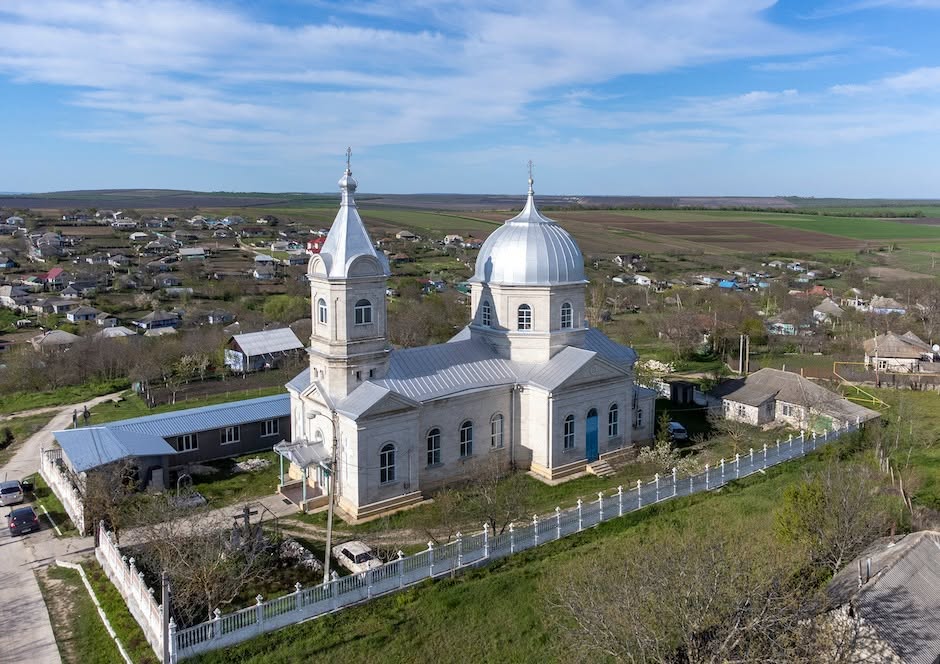
Saint Nicholas Parish
Church History
Hîrtopul Mic · Criuleni District · Republic of Moldova
Metropolis of Chișinău and All Moldova
The history of the church dedicated to ‘St Nicholas the Hierarch’ in the village of Hîrtopul Mic, Criuleni district.
The hermitage in Hîrtopul Mic was founded in the 18th century. In 1814, the elderly nun Anastasia Guţoaie, who had been the abbess of the hermitage for 36 years and was then 80 years old, complained to Metropolitan Gavril Bănulescu-Bodoni that “It will soon be 40 years since I entered monastic life, and through my own labours I have completely transformed the Hîrtopul hermitage, adorning the church with all that is necessary…”. We can deduce from this that the hermitage was refurbished between 1774 and 1778, having existed prior to this date.
Following our research, we have managed to uncover two previously unpublished documents relating to the hermitage’s final period of existence. The first of these dates from 1792 and is, in fact, the document in which the Hîrtop Hermitage is mentioned for the first time. It is a decree issued by Alexandru Constantin Moruzi, the then ruler of Moldavia, granting the Hîrtop Hermitage the right to bring in 10 men from abroad to carry out certain works.
Four years later, on 25 March 1796, the ‘Hîrtop Hermitage’ was exempted from taxes by Prince Alexandru Callimachi: ‘Ioan Alexandru Callimachi, Voivode, by the grace of God, Prince of Moldavia. By this letter of my reign, let it be made known to the Hîrtopul Hermitage in the district of Orhei that, in response to the petition submitted to ussubmitted, the nuns residing at that hermitage have shown that they possess letters of favour from other enlightened lords, beseeching me to confirm this through my own authority. … It is to be exempt from all tax payments to the treasury, as well as from other duties. Therefore, we command the lords of Orhei, the diligent officials and tax collectors, to ensure that all of them protect it exactly as set out above in this document…” (ANRM, fonds 220, inv. 2, file 752, passim.)
The decision to close the hermitage was taken on 23 October 1809. In this regard, Archimandrite Cyril wrote to Teodor, the treasurer of the Metropolis: “In accordance with the order received by the Consistory as early as last year, 1809, 23 October from His Most Holy Eminence Gavril, Exarch and Knight, regarding the arrangement between the Hîrtopul nunnery and the Ciurova hermitage in the district of Orheiul (Hirova – n.n.) … First, remove all the nuns from Ciurova and distribute them to other hermitages where they may settle; then proceed to the Hîrtopul nunnery and remove all the nuns from there, along with all their belongings, both movable and immovable, which have been produced through their own management and labour, with the exception of the iconostasis and the icons, which were made long ago through the charity of Christians, and take them to the Ciurova hermitage”.
At the beginning of 1810, the same Archimandrite Cyril stated: ‘…The Hîrtopul hermitage, as has been understood, is in a very poor state; indeed, the roof has been damaged by the rain… Once the nuns have been removed… you shall close the church at Hîrtopul until the inhabitants there have restored it and furnished it with all that is necessary for the celebration of the holy service: books, vestments, sacred vessels and bells, replacing them with new ones; and then, after notifying the Metropolitanate of what you intend to do, you shall be granted permission to conduct services, the church remaining a parish church and not a hermitage…”.
We also know that the transfer of the nuns took place between 1811 and 1812. With the Metropolitan’s permission, only the elderly nun Anastasia Guţoaie, the former abbess, and three other elderly nuns remained here. Metropolitan Gavril took this decision at the request of the former abbess, adding to his resolution: ‘At the church, which is now a parish church, they are in no way to be commanded, nor to be disturbed, and they are to live in peace’ (ANRM, fonds 205, inv. 1, file 544, f. 1–3; Archives of Bessarabia, 1935, no. 2, pp. 120–122.)
The Church dedicated to Saint Nicholas. The earliest records concerning the Church dedicated to Saint Nicholas in Hîrtopul Mic date back to 1813. In that year, in a petition addressed to Metropolitan Gavril, the brothers of the Cotruţă family, Brâncă, Grigore Boaghe and Gheorghe Roşea stated that the Church of St Nicholas on the Hârtopul estate had been built by their forefathers and ancestors to serve as a hermitage, “as it is situated in a beautiful spot, in the forest, and so that the memory of their forefathers and ancestors might not be lost”. They requested that a hermitage be re-established there “with 20–30 nuns”. The response was negative “because the hermitage’s church had been designated as a parish church” (Archives of Bessarabia, 1935, no. 2, pp. 123–124). During the same period, various sources indicate that ‘a parish priest and a lay steward from among the peasants’ served at this church. The holy place was built of wood, was in a satisfactory condition and was adequately supplied with books and icons. (The Clergy of the Churches in the Districts of Orhei and Lăpuşna (1813), Chișinău, 1934, p. 13; Proceedings of the Bessarabian Provincial Educational and Archival Commission, vol. 3, Chișinău, 1907, p. 243.)
In the second half of the 1830s, the church was granted ownership of agricultural land with a total area of 33 desetines. We learn some details about this from a petition dated 1834 from the priest Nicolae Şt. Popescu to the higher ecclesiastical authorities. In the petition, he mentioned that at that time there were 21 households in the village of Hîrtopul Mic, all of whose inhabitants were free peasants. The aforementioned priest wrote that, over the course of several years, the free peasants in the village had promised to give him land, but had given him nothing, postponing the matter indefinitely. Citing his family’s precarious financial situation, Father Nicolae asked the higher authorities to intervene to resolve the issue of the agricultural land as a matter of urgency. The relevant authorities reacted immediately to this request, informing the villagers that if the church were not granted the 33 desetines to which it was legally entitled, the church would be closed, and the villagers would be transferred to the nearest parish. The residents of Hîrtopul Mic replied that they wished to give land to the church, but their estate was so small that they themselves were forced to lease land from the owners of neighbouring estates. The authorities then set the following condition: either they provide the priest’s family with an annual salary of 400 roubles, or, if they did not agree, the priest would be transferred to another village, and the church in Hîrtopul Mic would be closed, with all its contents transferred to the Church of St Michael in Hârtopul Mare. In the end, the Christians of Hîrtopul Mic decided to grant the church the land to which it was entitled, so that at the beginning of 1836, by official order, the parish was granted 33 desetines of arable land ‘from the Cotelniceni estate, which is now called Hârtopul Mic’. (ANRM, fonds 208, inv. 2, file 1041, f. 1–2, 4, 9, 13, 19.)
The church in Hîrtopul Mic was served for a long period by priests from the Popescu family. The 1835 census recorded the names of all those serving at the village church at that time, including their family members. These were the priest Nicolae Şt. Popescu (aged 40), his wife Irina (aged 33), and their children: Gheorghe (aged 11), Vasile (aged 10), Gheorghe (aged 6) and Pelagheia (aged 2); 2) the deacons – Mihail S. Ciubuc (aged 25), Gavrilă I. Florea (aged 34) and the latter’s wife – Efrosinia (aged 26); 3) the sacristan – Ion M. Usinevici (aged 18), his mother Tatiana Usânevici (aged 49), and his brothers and sisters: Alexandru (aged 21), Fiocla (aged 17) and Eudochia (aged 10). (ANRM, fonds 134, inv. 2, file 63, f. 17 verso–18). In 1846, thanks to the efforts of the priest Nicolae, the old wooden church was rebuilt in stone.
In the 1860s–1890s, the parish priest was Father Nicolae’s son, Dumitru N. Popescu. Priests Nicolae and Dumitru Popescu were initially buried in the churchyard, and their remains were later reburied in the village cemetery. The role of deacon was held for a time by Ion Sârbu, and later by Gheorghe Bolfun. The church sexton was, until the late 1970s, the same Ion M. Usinevici. (ANRM, collection 211, inv. 5, file 224, f. 135 verso–136; Ibid., file 204, fol. 123 verso, 125 etc.; Ibid., fonds 2069, inv. 1, file 3281, fol. 22; see also P. A. Lotoţki, List and brief biographies of those who completed the full course at the Chișinău Theological Seminary over 100 years of its existence (1813–1913), Chişinău, 1913, p. 36.)
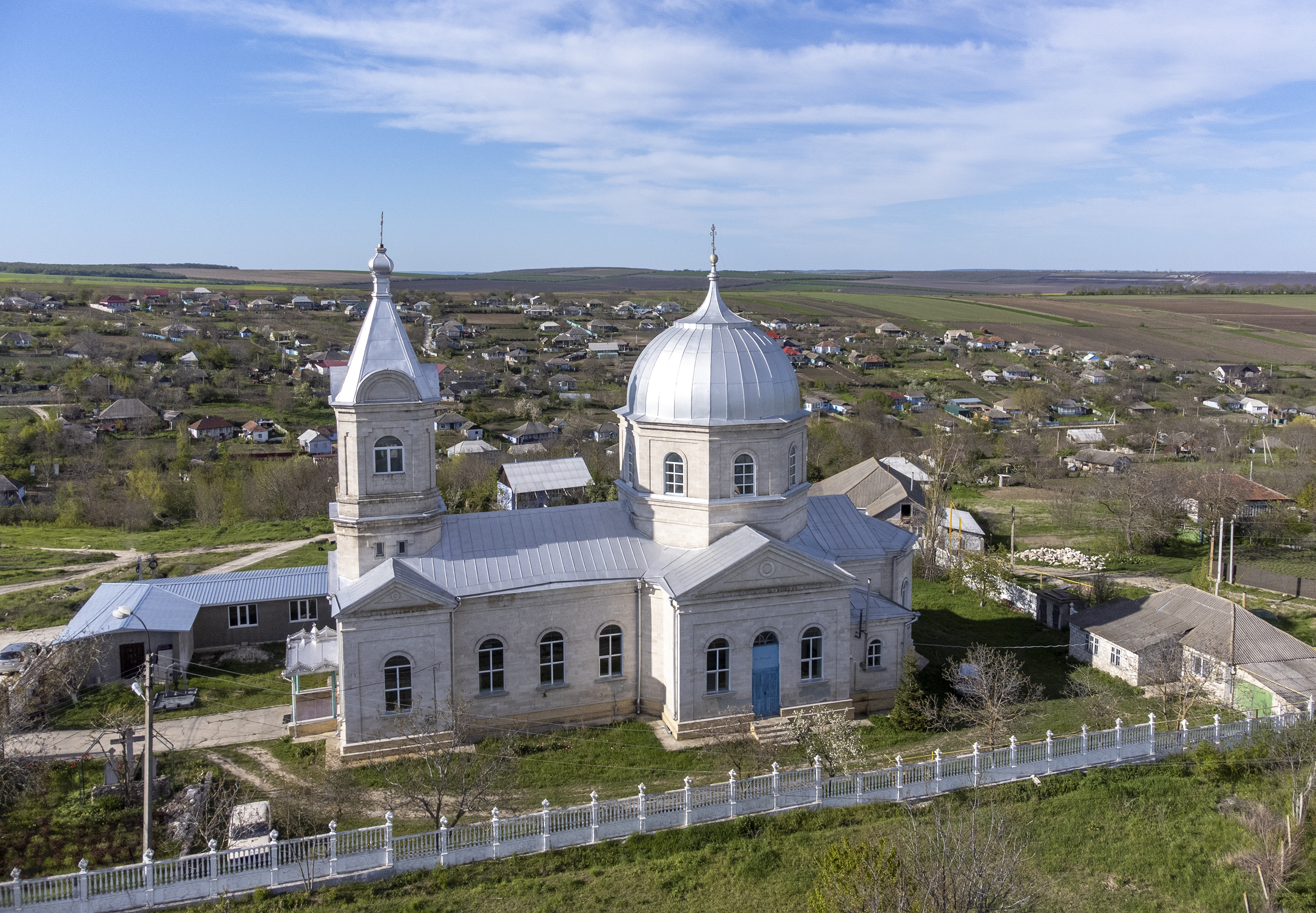
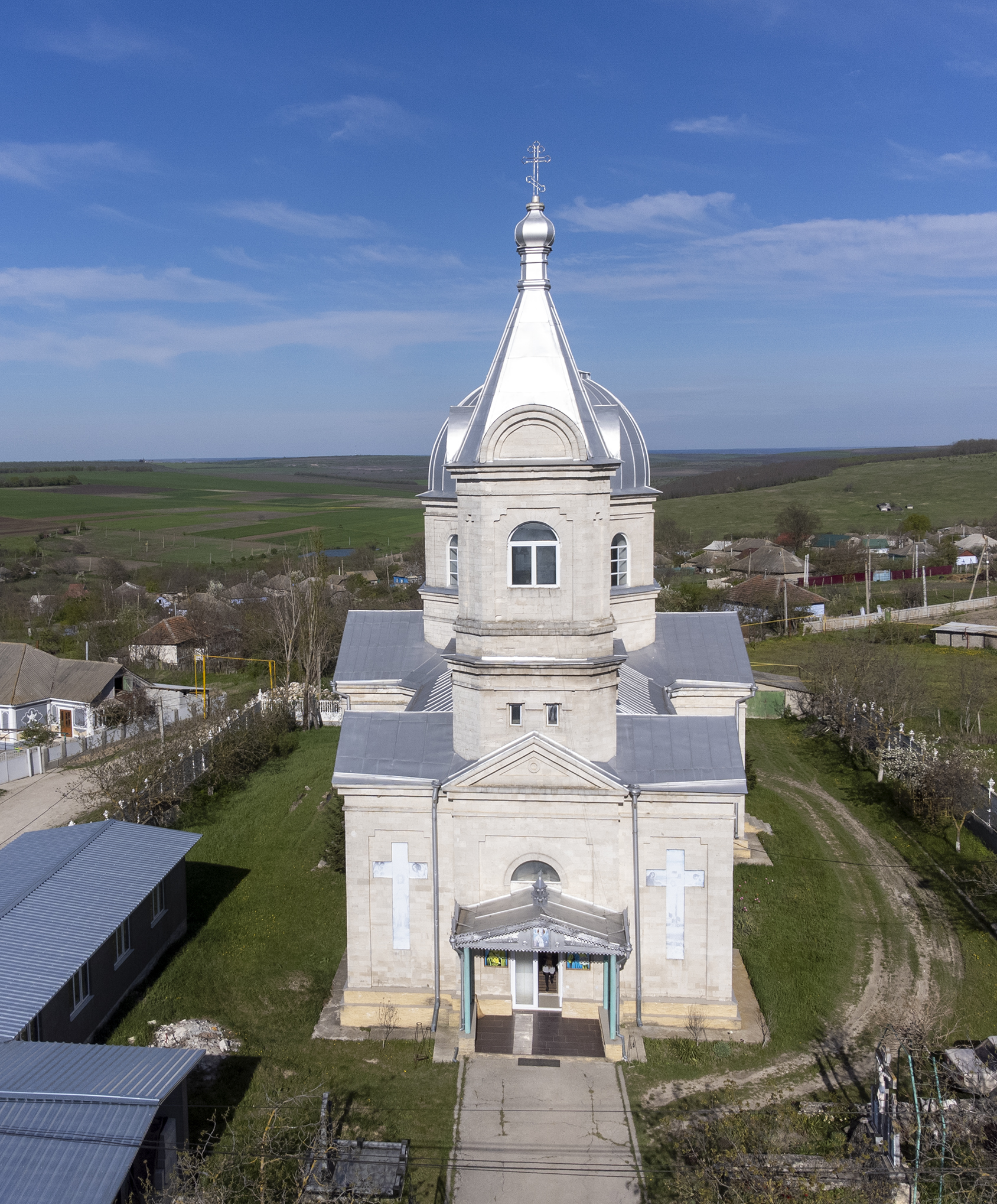
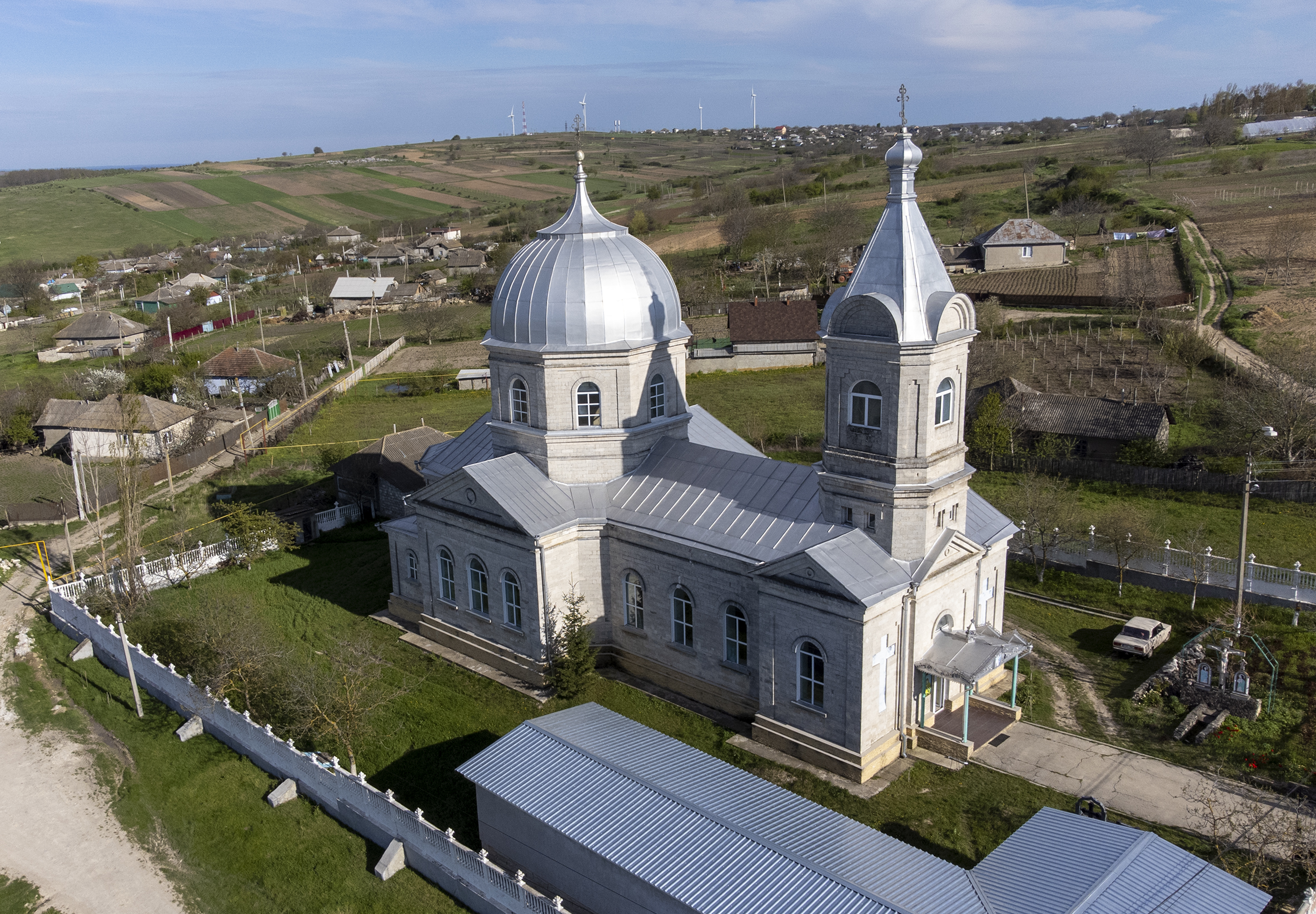
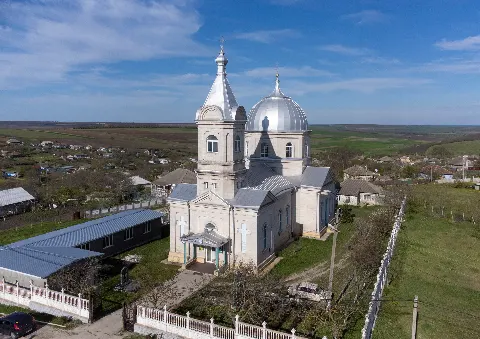
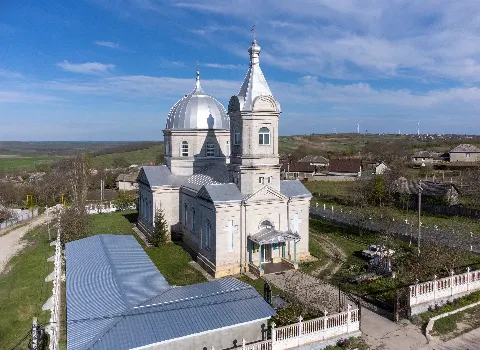
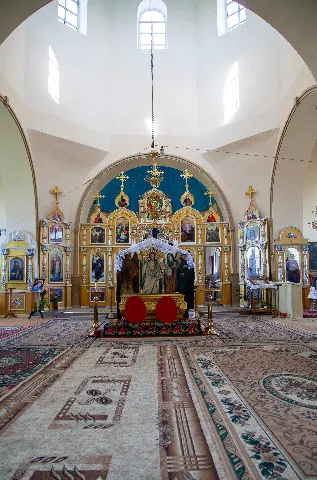
According to the elders, the old church remained in use until the late 1930s. In 1933, work began in the village on the construction of a new church, the present-day building. It was completed between 1938 and 1939. The cross, like the other items from the old church, was then transferred to the new church (on the hill). From a report by the Hîrtop local council, dated 1941, we learn several interesting details about the two churches and the village cemetery: ‘The new church is situated in the centre of the village of Hîrtopul Mic at a place known as “Privai”. It is an Orthodox Christian church, cruciform in plan, built of wattle and daub, with oval vaults and two spires: one pyramidal and one spherical, currently under construction. It consists of a single room for religious worship. The church plot in the village of Hîrtopul Mic covered an area of 18 ha. It was known as ‘Şabana’; this was confirmed by the Land Reform Act of 13 March 1920. The value of this land is 180,000 lei. … The courtyard of the parish house in the village of Hîrtopul Mic. The area is 1,666 m², and it is situated on the outskirts of the village of Hîrtopul Mic. Neighbours: to the north, Andrei Grama; to the south, Teodor Cristea; to the east, a road; and to the west, Mihail Suveică”.
Until 1958, the year in which the church in Hîrtopul Mic was closed, Father Zaharia(?) served here. At the same time, on the orders of the Soviet occupation authorities, the old church was demolished down to its foundations, and the village ‘club’ was built from its stones (today, only a ‘waycross’ erected on the site of the former altar serves as a reminder of the old church). Initially, the new church was used as a storehouse for the local kolkhoz (for storing sunflower seeds, tobacco, etc.). Most of the church’s old icons and books were then taken to the church in Hîrtopul Mare.
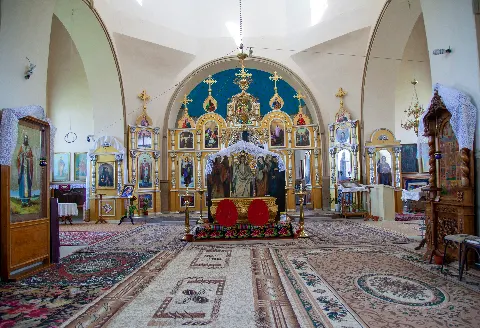
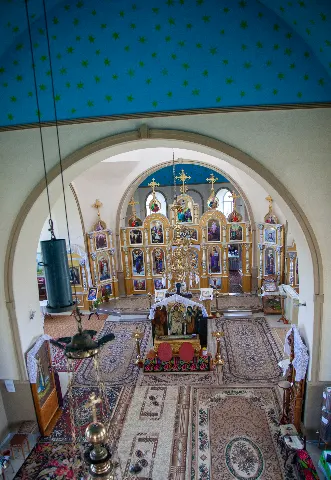
In the late 1980s, the villagers pressed the authorities to allow them to repair the church building so that it could be turned into a museum. Following the declaration of independence of the Republic of Moldova on 14 November 1992, the village church was consecrated and reopened. In the final years of the communist regime, the parish of Hîrtopul Mic was served by Father Iosif Crudu, the parish priest of the church in Hîrtopul Mare. On 21 November 1992, Father Gheorghe Danilov was appointed parish priest of the church. Ion Pârvu served as church warden and is credited with organising the reconstruction work on the church. From 1993 until 2003, this role was held by Maria Grosu.
On 3 August 2021, by metropolitan decree, Father Marin Grigoriță was appointed parish priest of this Holy Place; he continues to serve with zeal and love for God and the people to this day.
Photo Gallery
Video
Videos will be added by the administrator.
Supporting the restoration works of this holy place is an act of blessing for future generations.
Support the restoration of the church